The COVID-19 pandemic is definitely still happening in this world. The number of cases are rising rapidly every day. Unfortunately, the death rate is still increasing. This pandemic is far from over if we look at these shocking and devastating statistics!
Linguosco would like to remind everyone something very important:
Stay at home as much as possible for the sake of everyone’s safety, including your own.
Let’s help stop the spread of Coronavirus!
Linguosco has some Work From Home tips that may benefit you during this extremely tough time! 🏡
1. Create a routine to keep your mind and body productive. 📝🏃
2. Keep communication lines open. 📲📞
3. Set up your work-space. 🏠📠
4. Focus on what needs to be done daily. ☑💯
5. Take a break. 😴📺
Don’t let this pandemic turn you into an unproductive person! Keep fighting! 💪
Stay healthy and safe! Keep your head up high and hope that everything will get better in the future! 🙏🙏🙏
Good luck! 😊👌👍
Contact us now ☎📞📩:
Website: www.linguosco.com
E-mail: info@linguosco.com
WhatsApp: +62 851-5511-8770
Instagram: @linguosco
Twitter: @linguosco
Line: https://lin.ee/9EGO9me or @406mnlkn
Facebook: www.facebook.com/linguosco
LinkedIn: Linguosco
YouTube: Linguosco Consultancy
Kami menyediakan semua jenis layanan di atas sesuai dengan kebutuhan dan keperluan kamu. Belum menemukan apa yang dicari? Langsung kontak kami di +62 851-5511-8770 (WhatsApp Linguosco: fast response) atau email ke info@linguosco.com untuk informasi lebih lanjut.
Contact us now ☎📞📩:
Website: www.linguosco.com
E-mail: info@linguosco.com
WhatsApp: +62 851-5511-8770
Instagram: @linguosco
Twitter: @linguosco
Line: https://lin.ee/9EGO9me or @406mnlkn
Facebook: www.facebook.com/linguosco
LinkedIn: Linguosco
YouTube: Linguosco Consultancy
With the additional language options, Japanese and German, Linguosco offers 5 language options for services, which are:
1. Bahasa Indonesia 🇮🇩
2. English 🇬🇧
3. French 🇫🇷
4. Japanese 🇯🇵
5. German 🇩🇪
For translation services, Linguosco offers:
1. Bahasa Indonesia – English (🇮🇩-🇬🇧)
2. English – Bahasa Indonesia (🇬🇧-🇮🇩)
3. Bahasa Indonesia – French (🇮🇩-🇫🇷)
4. French – Bahasa Indonesia (🇫🇷-🇮🇩)
5. English – French (🇬🇧-🇫🇷)
6. French – English (🇫🇷-🇬🇧)
7. Bahasa Indonesia – Japanese (🇮🇩-🇯🇵)
8. Japanese – Bahasa Indonesia (🇯🇵-🇮🇩)
9. English – Japanese (🇬🇧-🇯🇵)
10. Japanese – English (🇯🇵-🇬🇧)
11. Bahasa Indonesia – German (🇮🇩-🇩🇪)
12. German – Bahasa Indonesia (🇩🇪-🇮🇩)
13. English – German (🇬🇧-🇩🇪)
14. German – English (🇩🇪-🇬🇧)
We look forward to work with you and be your language consultancy in the near future! 😊👍
Contact us now ☎📞📩:
Website: www.linguosco.com
E-mail: info@linguosco.com
WhatsApp: +62 851-5511-8770
Instagram: @linguosco
Twitter: @linguosco
Line: https://lin.ee/9EGO9me or @406mnlkn
Facebook: www.facebook.com/linguosco
LinkedIn: Linguosco
YouTube: Linguosco Consultancy
Linguosco is extremely excited to announce the launching of our newest language option for our services:
GERMAN! 🇩🇪🇩🇪🇩🇪
DEUTSCH! 🇩🇪🇩🇪🇩🇪
🍺🍻🍺🍻
Welcome! 👋
Willkommen! 👋
As of today, we are available for those who need help on translating German documents into Bahasa Indonesia or English documents! 🇩🇪-🇮🇩-🇬🇧 (vice versa) 📃📃📃
We work with a team of translators who excel in the German language and have been living in Germany for years. So, your documents will be in good hands when you use our services! Satisfaction guaranteed! 💯💯💯
We look forward to work with you and be your language consultancy in the near future! 😊👍
Thank you so much! 🙏🙏🙏
Danke schön! 🙏🙏🙏
Contact us now ☎📞📩:
Website: www.linguosco.com
E-mail: info@linguosco.com
WhatsApp: +62 851-5511-8770
Instagram: @linguosco
Twitter: @linguosco
Line: https://lin.ee/9EGO9me or @406mnlkn
Facebook: www.facebook.com/linguosco
LinkedIn: Linguosco
YouTube: Linguosco Consultancy
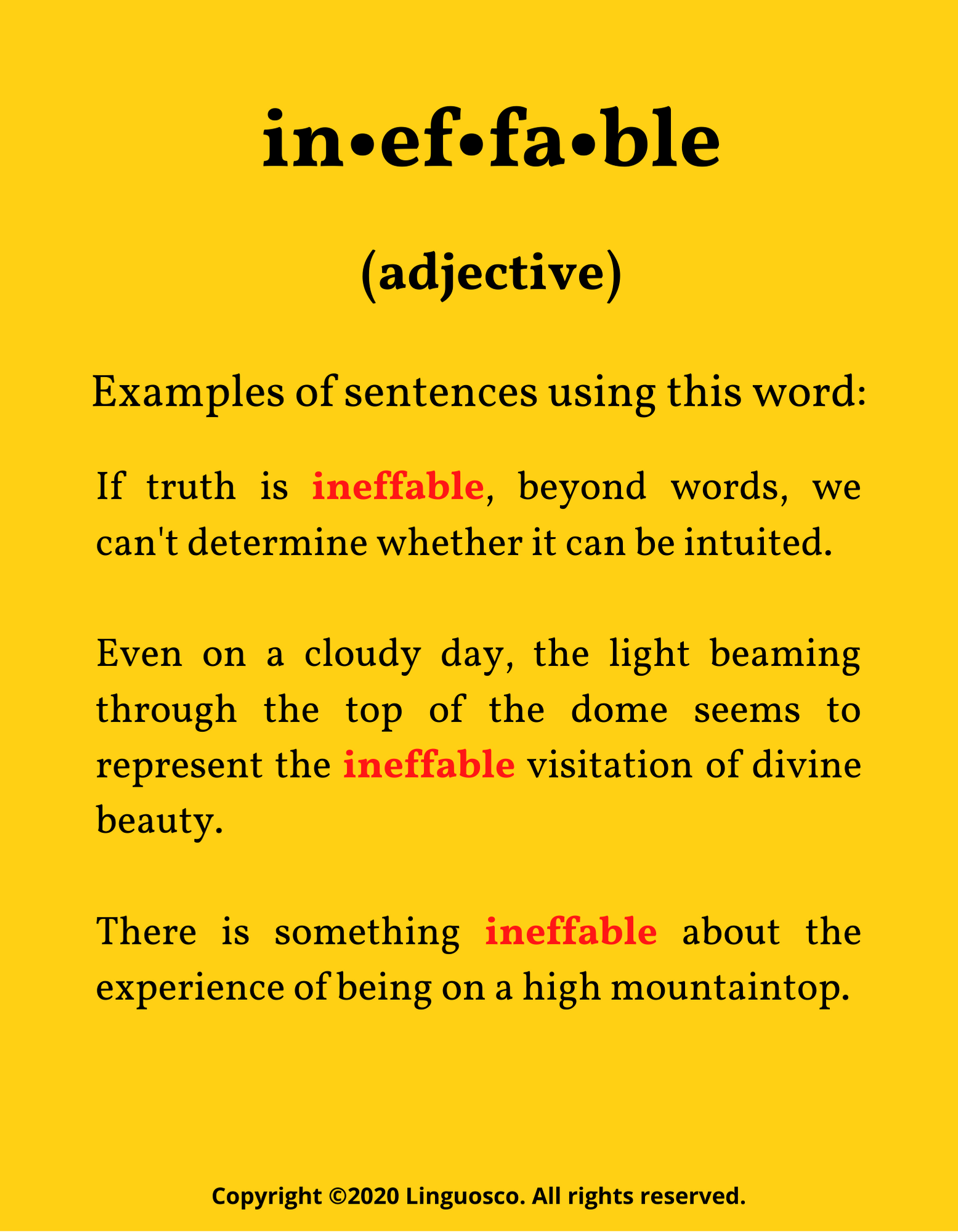
Have you ever heard, read, or used the word ineffable? Do you know what this word means? ❓❓❓
Ineffable is rarely used during daily conversations. Many have considered this word as a fancy and posh English word that are usually used during formal conversations.
Fun fact: not everyone knows what this word means and some aren’t even aware of this word’s existence!
So, what does this word actually mean?
According to Oxford Dictionary, the definition of ineffable is:
“too great or beautiful to describe in words.”
In other words, ineffable means incapable of being expressed or described in words; inexpressible.
As stated by Merriam-Webster Dictionary, the synonyms of ineffable include indefinable, inexpressible, indescribable, unspeakable, and unutterable. The anonyms of ineffable include communicable, describable, expressible, and speakable. (Adipex)
Ineffable is an adjective that describes a situation that causes so much emotion, especially pleasure, that the situation itself can’t be described.
Anything ineffable is unspeakably beautiful, moving, or horrible. It’s beyond expression. If something is so powerful or emotional that you can’t even describe it, it’s ineffable.
Ineffable ideas and emotions are difficult to put into words. For instance, parents might feel an ineffable sadness and pride when watching their youngest child graduate from high school.
📌Stay tuned for more Word of the Week by Linguosco every Sunday!📌
Contact us now ☎📞📩:
Website: www.linguosco.com
E-mail: info@linguosco.com
WhatsApp: +62 851-5511-8770
Instagram: @linguosco
Twitter: @linguosco
Line: https://lin.ee/9EGO9me or @406mnlkn
Facebook: www.facebook.com/linguosco
LinkedIn: Linguosco
YouTube: Linguosco Consultancy
Every Sunday, Linguosco will provide a lesson about one (or two if necessary) unique English word to enrich your English vocabulary! We will explain about the chosen word thoroughly to make you understand more! 📙📓📔
Sunday is not an excuse to be unproductive! You must make the most out of every single day of the week. This includes Sunday! Learning about a new word every Sunday is certainly better than nothing! 😁👍
This week’s Word of the Week will be on the next post! Stay tuned!🚩
Make sure to stay tuned every Sunday to find out what English word we are going to discuss! 😊👌
Contact us now ☎📞📩:
Website: www.linguosco.com
E-mail: info@linguosco.com
WhatsApp: +62 851-5511-8770
Instagram: @linguosco
Twitter: @linguosco
Line: https://lin.ee/9EGO9me or @406mnlkn
Facebook: www.facebook.com/linguosco
LinkedIn: Linguosco
YouTube: Linguosco Consultancy
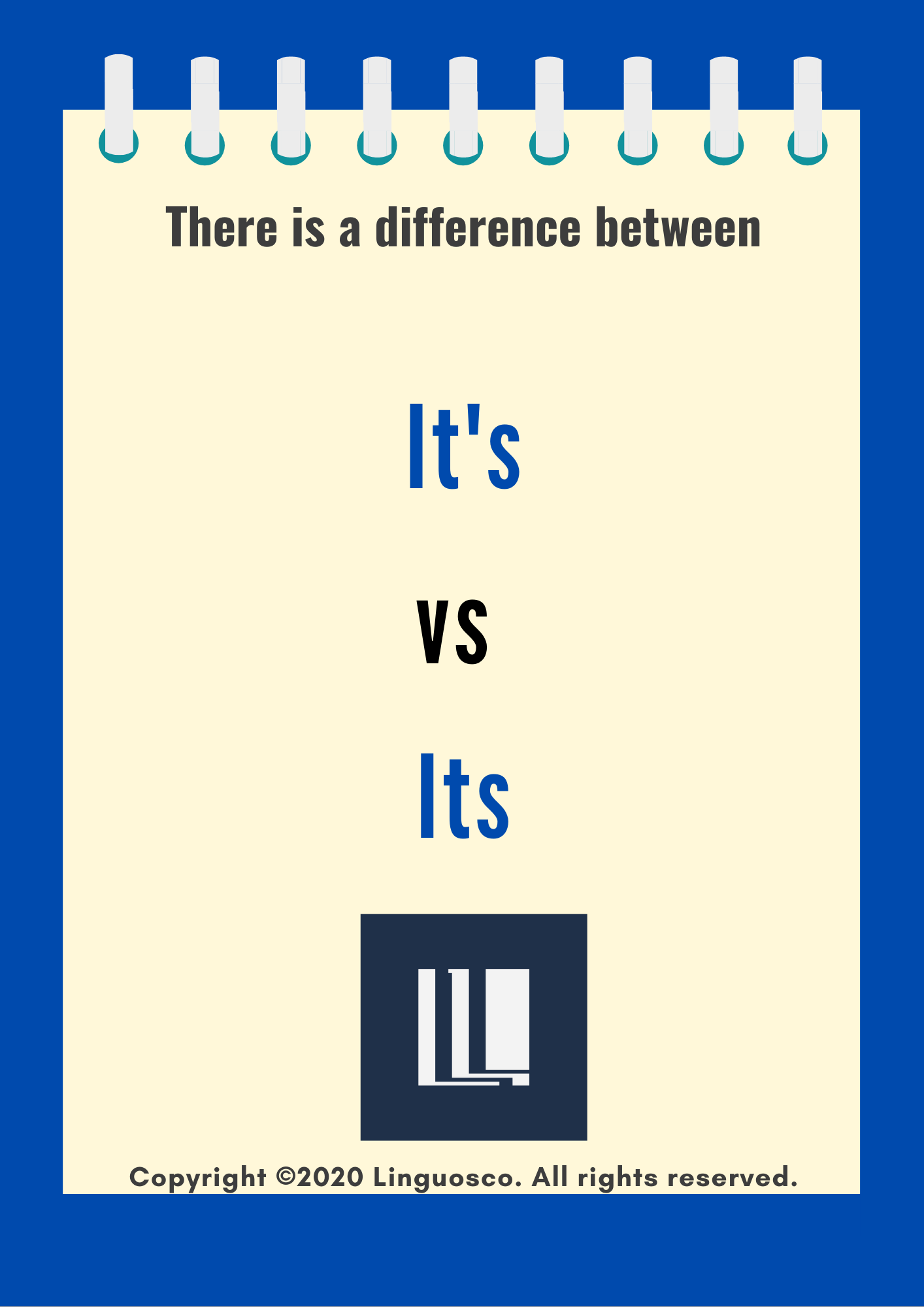
Have you ever come across someone who mixes up “It’s” and “Its” wrongly? Have you have heard someone who uses these terms incorrectly that may lead to an unwanted miscommunication? Do you still find it difficult or confusing to differentiate these terms?
Every term in the English language has its own meaning and function, even the terms that are or sound almost identical. It may be fatal if you misuse a term, both in your conversations or written documents. 💬📄
When you’re in a hurry, you might write or say “it’s” when you really mean “its,” or the other way around. You need to be aware of this mistake and know when to use which.
So, what is the difference between “It’s” and “Its”?
No worries! As always, we got you covered! 😊👍
First things first, “it” is a third-person singular neuter pronoun, used (among other ways) to stand in for inanimate things or ideas.
📌 It’s
It’s is a contraction of the words “it is” or “it has”. Interestingly, we don’t really contract “it was” into it’s.
A contraction is a shortened form of a word or group of words with the omitted letters often replaced in written English by an apostrophe.
Let’s look at some examples:
“She misplaced her phone, but she thinks it’s in the car.”
Did we use yes it’s correctly? Yes, as we can tell if we write out “it’s” fully:
“She misplaced her phone, but she thinks it is in her car.”
“Your parents are coming into town tomorrow morning,” Jess said. “We need to clean the house, and it’s got to be done today.”
In this instance, “it’s” is contracted from “it has got”.
📌 Its
Its is the possessive form of it, used to indicate possession, ownership, belonging, etc.
English generally uses apostrophes to indicate possession, for example, Mary’s bike (the bike belonging to Mary) and the lions’ roars (the roars of the lions). But, confusingly, English does not use apostrophes when showing possession for personal pronouns: yours, ours, theirs, his, hers, and … its.
The reason we don’t use an apostrophe to show a possessive is long and complicated, but here are few fun facts:
1. Way back when in English, we used “his” for the possessive form of “it”.
2. The use of its for the possessive form of it takes off in the 1500s.
For example:
“The hotel raised its rates.” ✅
Let’s try and swap in “it is”:
“The hotel raised it is rates.” ❌
This sentence doesn’t make sense. “Its” conveys that the rates belong to the hotel.
Other correct examples:
“The car needed its brakes repaired.”
“The house, while old, really has its charms.”
We hope we were able to explain to you about the terms “It’s” and “Its” clearly. It takes a lot of practice and dedication to excel in English grammar. Never stop practicing! 👍💪✊
Stay tuned for more Grammar 101 by Linguosco to improve your English grammar! 👌
Contact us now ☎📞📩:
Website: www.linguosco.com
E-mail: info@linguosco.com
WhatsApp: +62 851-5511-8770
Instagram: @linguosco
Twitter: @linguosco
Line: https://lin.ee/9EGO9me or @406mnlkn
Facebook: www.facebook.com/linguosco
LinkedIn: Linguosco
YouTube: Linguosco Consultancy
Have you ever come across someone who mixes up “I like…” and “I’m like…” wrongly? Have you have heard someone who uses these terms incorrectly that may lead to an unwanted miscommunication? Do you still find it difficult or confusing to differentiate these terms?
Every term in the English language has its own meaning and function, even the terms that are or sound almost identical. It may be fatal if you misuse a term, both in your conversations or written documents. 💬📄
So, what is the difference between “I like…” and “I’m like…”?
No worries! As always, we got you covered! 😊👍
📌 “I like…”
“I like” is simple present, and we use this to talk about what we like in general. After “I like”, you can use either the to form of the verb or the -ing form.
For example:
“I like to read,” or “I like reading.” 📖
There’s no difference. They’re both grammatically correct. ✅
This term may also show admiration or likeness towards someone or something.
For example:
“I like Michael Jackson.” 🎤🎶
“I like apples.” 🍎🍏
📌 “I’m like…”
“I’m like…” or “I am like…” is a term used as a preposition. Unlike the term “I like…”, this term doesn’t express what we like. It shows what we are like or what we resemble.
According to Dictionary.com, this term means:
“in like manner with; similarly to; in the manner characteristic of.”
This term’s main function is to show one’s resemblance towards something or someone.
For example:
I’m just like my father. 👦➡👨
I am like you: hilarious. 😁
We hope we were able to explain to you about the terms “I like…” and “I’m like…” clearly. It takes a lot of practice and dedication to excel in English grammar. Never stop practicing! 👍💪✊
Stay tuned for more Grammar 101 by Linguosco to improve your English grammar! 👌
Contact us now ☎📞📩:
Website: www.linguosco.com
E-mail: info@linguosco.com
WhatsApp: +62 851-5511-8770
Instagram: @linguosco
Twitter: @linguosco
Line: https://lin.ee/9EGO9me or @406mnlkn
Facebook: www.facebook.com/linguosco
LinkedIn: Linguosco
YouTube: Linguosco Consultancy
Have you ever come across someone who mixes up the words advise and advice wrongly? Have you have heard someone who uses these words incorrectly that may lead to an unwanted miscommunication? Do you still find it difficult or confusing to differentiate these words?
Every word has its own meaning and function, even the words that are almost identical. It may be fatal if you misuse a word, both in your conversations or written documents. 💬📄
So, what is the difference between advise and advice?
No worries! As always, we got you covered! 😊👍
According to Dictionary.com:
📌Advise
Advise is a VERB.
Meaning: “to give counsel to; offer an opinion or suggestion as worth following.”
📌Advice
Advice is a NOUN.
Meaning: “an opinion or recommendation offered as a guide to action, conduct, etc.”
Some of the confusion surrounding these terms may be attributable to the subtle spelling differences, particularly when it comes to the use of the letter C versus the letter S (between British and American English). 🇬🇧🇺🇸
For instance, in British English, the words practice and practise are different parts of speech (noun and verb, respectively).
Meanwhile, in American English, the word practice doubles as both a noun and a verb.
How do you use advise and advice in a sentence? ❓
Thankfully, regardless of the variety of English you’re dealing with, advice is always a NOUN and advise is always a VERB.
Examples:
She advised him not to smoke.
I asked Tom what he’d advise.
You’ve done this before, please give me your advice.
I need your advice on which car to buy.
We hope we were able to explain to you about the words advise and advice clearly. It takes a lot of practice and dedication to excel in English grammar. Never stop practicing! 👍💪✊
Stay tuned for more Grammar 101 by Linguosco to improve your English grammar! 👌