Linguosco offers 5 language options for services, which are:
1. Bahasa Indonesia 🇮🇩
2. English 🇬🇧
3. French 🇫🇷
4. Japanese 🇯🇵
5. German 🇩🇪
For translation services, Linguosco offers:
1. Bahasa Indonesia – English (🇮🇩-🇬🇧)
2. English – Bahasa Indonesia (🇬🇧-🇮🇩)
3. Bahasa Indonesia – French (🇮🇩-🇫🇷)
4. French – Bahasa Indonesia (🇫🇷-🇮🇩)
5. English – French (🇬🇧-🇫🇷)
6. French – English (🇫🇷-🇬🇧)
7. Bahasa Indonesia – Japanese (🇮🇩-🇯🇵)
8. Japanese – Bahasa Indonesia (🇯🇵-🇮🇩)
9. English – Japanese (🇬🇧-🇯🇵)
10. Japanese – English (🇯🇵-🇬🇧)
11. Bahasa Indonesia – German (🇮🇩-🇩🇪)
12. German – Bahasa Indonesia (🇩🇪-🇮🇩)
13. English – German (🇬🇧-🇩🇪)
14. German – English (🇩🇪-🇬🇧)
We look forward to working with you and be your language consultancy in the near future! 😊👍
Contact us now ☎📞📩:
Website: www.linguosco.com
E-mail: info@linguosco.com
WhatsApp: +62 851-5511-8770
Instagram: @linguosco
Twitter: @linguosco
Line: https://lin.ee/9EGO9me or @406mnlkn
Facebook: www.facebook.com/linguosco
LinkedIn: Linguosco
YouTube: Linguosco Consultancy
Have you ever heard, read, or used the word calamitous? Do you know what this word means? ❓❓❓
Calamitous is an adjective that is uncommonly used, especially amongst the youth. 👥💬
This word sounds similar to one seafood item, which is calamari, which is squid serves as food. These two words have completely different meanings. Besides that, one is an adjective (calamitous) and the other is a noun (calamari).
So, what does this word actually mean?
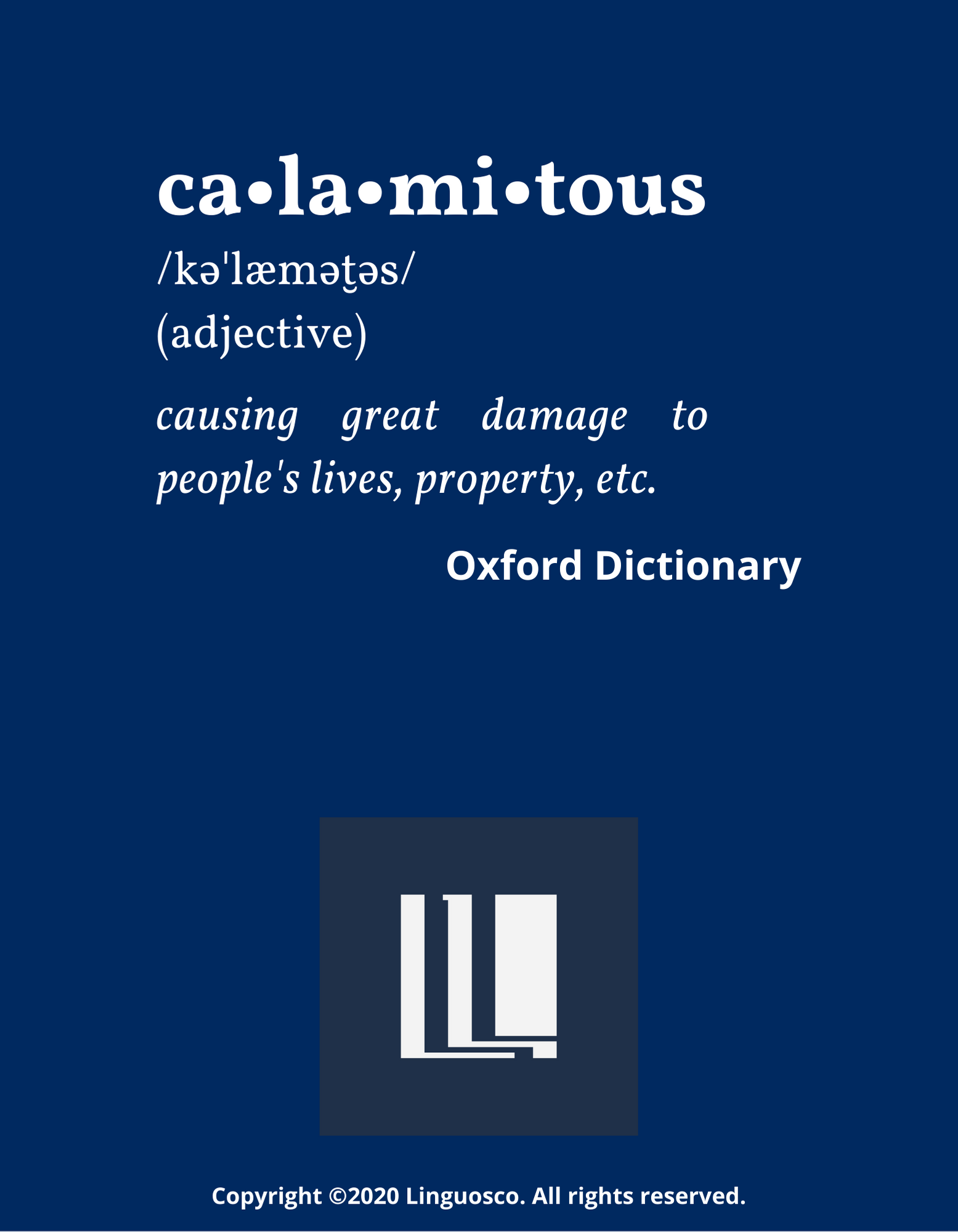
According to Oxford Dictionary, the definition of calamitous is:
“causing great damage to people’s lives, property, etc.”
Calamitous is an adjective that is generally used to describe events, and these events are disastrous or destructive. For instance, a failed election can be a calamitous event for a politician.
If you describe an event or situation as calamitous, you mean it is very unfortunate or serious.
As stated by Merriam-Webster Dictionary, the synonyms of calamitous are catastrophic, damning, destructive, disastrous, fatal, ruinous, and unfortunate. The antonyms of calamitous are nondestructive and fortunate.
The definition of calamitous is something that causes or tends to cause destruction. 💥
You can check out some examples of sentences using the word calamitous to understand the word more!
📌Stay tuned for more Word of the Week by Linguosco every Sunday!📌
Contact us now ☎📞📩:
Website: www.linguosco.com
E-mail: info@linguosco.com
WhatsApp: +62 851-5511-8770
Instagram: @linguosco
Twitter: @linguosco
Line: https://lin.ee/9EGO9me or @406mnlkn
Facebook: www.facebook.com/linguosco
LinkedIn: Linguosco
YouTube: Linguosco Consultancy
Every Sunday, Linguosco will provide a lesson about one (or two if necessary) unique English word to enrich your English vocabulary! We will explain about the chosen word thoroughly to make you understand more! 📙📓📔
Sunday is not an excuse to be unproductive! You must make the most out of every single day of the week. This includes Sunday! Learning about a new word every Sunday is certainly better than nothing! 😁👍
This week’s Word of the Week will be on the next post! Stay tuned!🚩
Make sure to stay tuned every Sunday to find out what English word we are going to discuss! 😊👌
Contact us now ☎📞📩:
Website: www.linguosco.com
E-mail: info@linguosco.com
WhatsApp: +62 851-5511-8770
Instagram: @linguosco
Twitter: @linguosco
Line: https://lin.ee/9EGO9me or @406mnlkn
Facebook: www.facebook.com/linguosco
LinkedIn: Linguosco
YouTube: Linguosco Consultancy
For the Instagram version of this post:
View this post on Instagram
[Linguosco: Delivering Crafted Excellence] 📝📄📃📑 Word of the Week: Part 12 📖🔍 Every Sunday, Linguosco will provide a lesson about one (or two if necessary) unique English word to enrich your English vocabulary! We will explain about the chosen word thoroughly to make you understand more! 📙📓📔 Sunday is not an excuse to be unproductive! (buckheadpaws.com) You must make the most out of every single day of the week. This includes Sunday! Learning about a new word every Sunday is certainly better than nothing! 😁👍 This week’s Word of the Week will be on the next post! Stay tuned!🚩 Make sure to stay tuned every Sunday to find out what English word we are going to discuss! 😊👌 Contact us now ☎📞📩: Website: www.linguosco.com E-mail: info@linguosco.com WhatsApp: +62 851-5511-8770 Instagram: @linguosco Twitter: @linguosco Line: https://lin.ee/9EGO9me or @406mnlkn Facebook: www.facebook.com/linguosco LinkedIn: Linguosco YouTube: Linguosco Consultancy #WordOfTheWeek #TheMoreYouKnow #linguosco #translation #translator #Indonesia #BahasaIndonesia #penerjemahbahasa #BahasaInggris #BahasaPrancis #Francais #Bahasa #professional #konsultansi #BahasaJepang #Indonesian #onlinetranslating #English #French #grammar #consultancy #curriculumvitae #jasapenerjemah #college #students #jasatranslate #writing #documents #language
We communicate with others by using phrases or expressions to show our reaction and emotions towards them or to simply state our opinions. Sometimes a facial expression isn’t enough to express how we feel. So, in order to make others understand our reaction, we must use the correct phrase/statement/expression. 💬💬💬
Make sure you don’t use the incorrect phrase/statement/expression because if you do, it can contradict to your reaction and have another meaning that opposes to the actual meaning.
For instance, we sometimes hear people write:
“Your welcome!”
It is GRAMMATICALLY INCORRECT. ❌
The correct way to say this phrase is:
“You’re welcome!”
This is grammatically correct. ✅
People often make the mistake of writing “Your welcome!” when it should be “You’re welcome!”. Since they both sound the same, it’s easy to make such an error.
Why is “Your welcome!” incorrect?
Your is a possessive pronoun. There is nothing possessive in “Your welcome!” because the word “welcome” is not an object. Thus, you can’t use it in this instance.
The correct answer is “You’re welcome!”. You’re is a contraction for “You are”. The technical phrase is “You are welcome!”. Therefore, this phrase is correct!
It takes a lot of practice and dedication to excel in English grammar. Never stop practicing! 👍💪✊
Stay tuned for more Grammar 101 by Linguosco to improve your English grammar! 👌
Contact us now ☎📞📩:
Website: www.linguosco.com
E-mail: info@linguosco.com
WhatsApp: +62 851-5511-8770
Instagram: @linguosco
Twitter: @linguosco
Facebook: www.facebook.com/linguosco
LinkedIn: Linguosco
YouTube: Linguosco Consultancy
Linguosco: Delivering Crafted Excellence] Grammar 101 – Part 2 📖✏ (Month 4)
We communicate with others by using phrases or expressions to show our reaction and emotions towards them or to simply state our opinions. Sometimes a facial expression isn’t enough to express how we feel. So, in order to make others understand our reaction, we must use the correct phrase/statement/expression. 💬💬💬
Make sure you don’t use the incorrect phrase/statement/expression because if you do, it can contradict to your reaction and have another meaning that opposes to the actual meaning. Besides that, your incorrect phrase can also be grammatically incorrect which can make others feel uncomfortable when they hear it.
For instance, we sometimes hear people say:
“I am agree!”
When they have the same opinion about something or someone with another person.
It is GRAMMATICALLY INCORRECT. ❌❌❌
“I am agree” doesn’t make sense.
Agree is a verb. This word means “to have the same opinion as somebody; to say that you have the same opinion”.
You can never add “to be” before a verb in English, unless it’s to form the continuous or the passive.
The correct way to say this phrase is:
“I agree!”
This is grammatically correct. ✅✅✅
We can say “I agree with you” or “I’m in agreement with you” (more formal).
We can also say “agree to” + verb, for the action resulting from the agreement.
For example:
“Anna agreed to help me with my homework after class.”
“My neighbor and I agreed not to play loud music after 10 PM.”
In summary:
“I agree” = Subject + Verb
Just like all other actions (run, eat, walk, talk, go), agree, too, is a verb.
“I am agree” = Subject + Verb + Verb (‘am’ and ‘agree’ both are verbs).
So, “I am agree” is incorrect.
It takes a lot of practice and dedication to excel in English grammar. Never stop practicing!
👍💪✊
Stay tuned for more Grammar 101 by Linguosco to improve your English grammar! 👌
Contact us now ☎📞📩:
Website: www.linguosco.com
E-mail: info@linguosco.com
WhatsApp: +62 851-5511-8770
Instagram: @linguosco
Twitter: @linguosco
Facebook: www.facebook.com/linguosco
LinkedIn: Linguosco
We communicate with others by using phrases or expressions to show our reaction and emotions towards them or to simply state our opinions. Sometimes a facial expression isn’t enough to express how we feel. So, in order to make others understand our reaction, we must use the correct phrase/statement/expression. 💬💬💬
Make sure you don’t use the incorrect phrase/statement/expression because if you do, it can contradict to your reaction and have another meaning that opposes to the actual meaning. Besides that, your incorrect phrase can also be grammatically incorrect which can make others feel uncomfortable when they hear it.
For instance, we sometimes hear people say:
“Worthed”
To describe something that is enjoyable or useful despite the fact that you have to make an effort.
It is GRAMMATICALLY INCORRECT. ❌❌❌
The correct ways to say this phrase is:
“Worth it” or simply use the adjective “worthy” in a sentence.
These are grammatically correct. ✅✅✅
“Worth it” is an expression to describe something or someone that is sufficiently good, enjoyable, or successful to repay any effort, trouble, or expense. It also means “enjoyable or useful despite the fact that you have to make an effort.”
For example: “It was a long climb to the top of the hill, but the view from the top was worth it!” 😄
So, be careful when you use this common English phrase! “Worthed” may sound similar to “worth it” but it has a totally different meaning.
“Worthed” is the past tense form of the verb “worth”, which means “equivalent in value to the sum or item specified.”.
It takes a lot of practice and dedication to excel in English grammar. Never stop practicing!
👍💪✊
Stay tuned for more Grammar 101 by Linguosco to improve your English grammar! 👌
Contact us now ☎📞📩:
Website: www.linguosco.com
E-mail: info@linguosco.com
WhatsApp: +62 851-5511-8770
Instagram: @linguosco
Twitter: @linguosco
Facebook: www.facebook.com/linguosco
LinkedIn: Linguosco
Have you ever heard, read, or used the word preposterous? Do you know what this word means? ❓❓❓
Preposterous is an adjective that is uncommonly used, especially amongst the youth because of its complexity. 👥💬
So, what does this word actually mean?
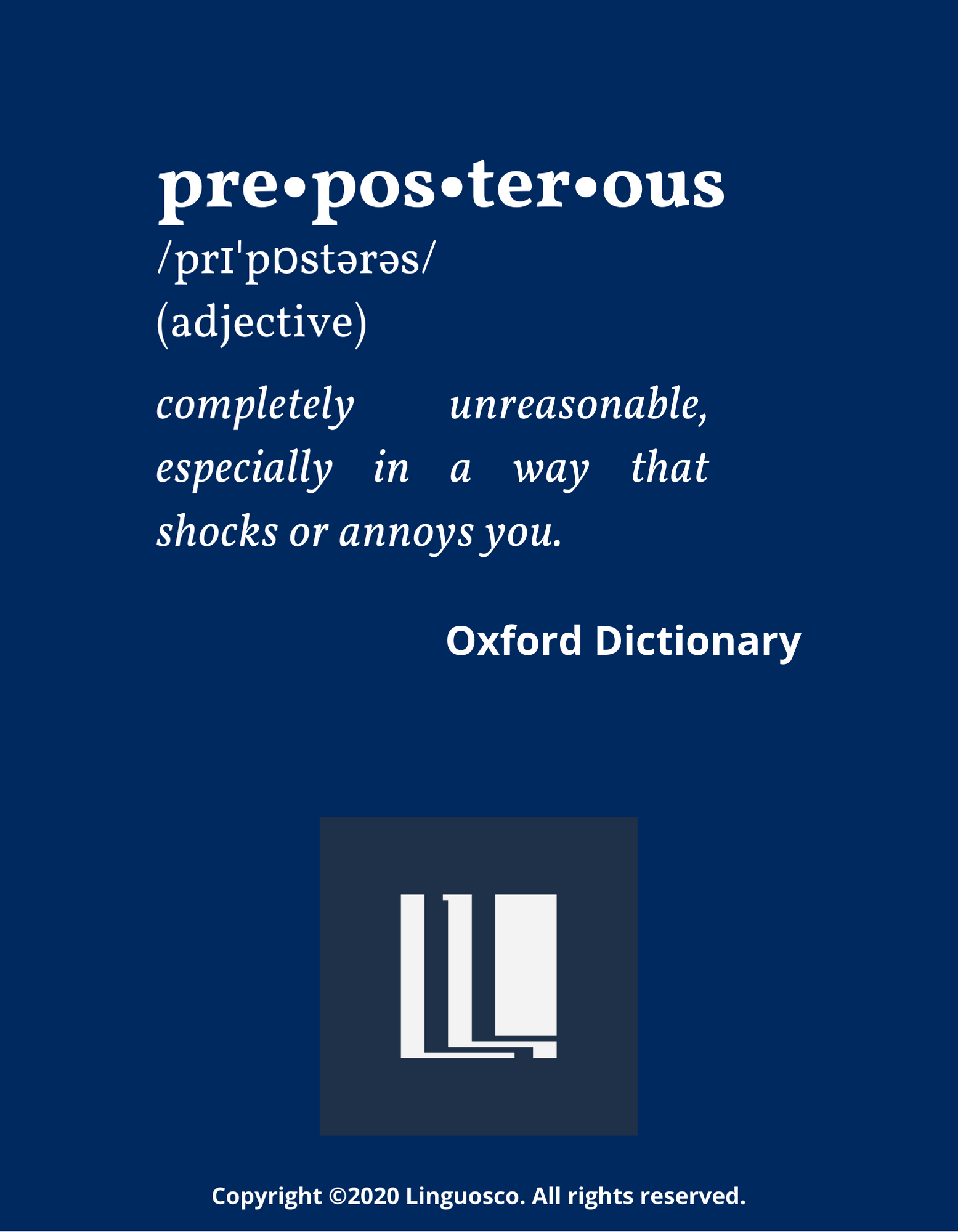
According to Oxford Dictionary, the definition of preposterous is:
“completely unreasonable, especially in a way that shocks or annoys you.”
Preposterous also means contrary to reason or common sense; utterly absurd or ridiculous. If you describe something as preposterous, you mean that it is extremely unreasonable and foolish.
As stated by Merriam-Webster Dictionary, the synonyms of preposterous are absurd, bizarre, crazy, fanciful, fantastic (also fantastical), foolish, insane, nonsensical, unreal, and wild. The antonyms of preposterous are realistic and reasonable.
The definition of preposterous is something that is absurd or ridiculous. An example of a preposterous idea is that the world is flat. 🌍
You can check out some examples of sentences using the word preposterous to understand the word more!
📌Stay tuned for more Word of the Week by Linguosco every Sunday!📌
Contact us now ☎📞📩:
Website: www.linguosco.com
E-mail: info@linguosco.com
WhatsApp: +62 851-5511-8770
Instagram: @linguosco
Twitter: @linguosco
Line: https://lin.ee/9EGO9me or @406mnlkn
Facebook: www.facebook.com/linguosco
LinkedIn: Linguosco
YouTube: Linguosco Consultancy
Every Sunday, Linguosco will provide a lesson about one (or two if necessary) unique English word to enrich your English vocabulary! We will explain about the chosen word thoroughly to make you understand more! 📙📓📔
Sunday is not an excuse to be unproductive! You must make the most out of every single day of the week. This includes Sunday! Learning about a new word every Sunday is certainly better than nothing! 😁👍
This week’s Word of the Week will be on the next post! Stay tuned!🚩
Make sure to stay tuned every Sunday to find out what English word we are going to discuss! 😊👌
Contact us now ☎📞📩:
Website: www.linguosco.com
E-mail: info@linguosco.com
WhatsApp: +62 851-5511-8770
Instagram: @linguosco
Twitter: @linguosco
Line: https://lin.ee/9EGO9me or @406mnlkn
Facebook: www.facebook.com/linguosco
LinkedIn: Linguosco
YouTube: Linguosco Consultancy
“The secret of getting ahead is getting started.” – Mark Twain ✨
In order to achieve something, you must start from where you are. It doesn’t matter how far your goals are and how unreachable they may be. Just start… start NOW. Not tomorrow, not the day after tomorrow, not next week, and not even next year. (Purchase Tramadol) The best time to start is always the present a.k.a. NOW.
Getting ahead won’t happen if you are not getting started. Imagining your goals may motivate you but actually getting started is more motivational!
Language is a vital tool for communication. It is not only a means of communicating thoughts and ideas, but it builds friendships, economic relationships and cultural ties.
A language shapes the way people perceive the world and it also helps to define culture of any society. Any language is a gift the knowledge of more than one language makes a man more efficient and skillful in many ways. The proper learning of language helps us to develop ourselves, our minds, and also our personality. 👦👧👨👩
Language undoubtedly has a very important social purpose because it is mainly used for linguistic communication.
That being said, our use of language towards other people reflects our point of views. It determines how people perceive us as an individual. 💬👥
Linguosco is capable to improve the language of those in need, specifically in written documents. Linguosco offers splendid translations services, cover letter writing, and resume/curicculum vitae writing. Linguosco provides translations for:
Bahasa Indonesia 🇮🇩
English 🇬🇧
French 🇫🇷
Japanese 🇯🇵
German 🇩🇪
Your documents are in good hands if you choose Linguosco as your language consultancy. Linguosco delivers crafted excellence. ✨📝
Contact us now ☎📞📩:
Website: www.linguosco.com
E-mail: info@linguosco.com
WhatsApp: +62 851-5511-8770
Instagram: @linguosco
Twitter: @linguosco
Facebook: www.facebook.com/linguosco
LinkedIn: Linguosco